

How Much Does It Cost to Sell a House in Ontario in 2026? A Net-Proceeds Guide

Most sellers know roughly what their home might sell for. Far fewer know what they will actually keep after the mortgage is paid, the fees come out, and the moving truck has left the driveway.
That gap matters. It is the difference between thinking you have enough for the next place and knowing you do. It is also where people get caught out when they are buying and selling at the same time.
A home selling for $1.1 million does not put $1.1 million in your account. Your mortgage lender gets paid first. Your selling costs come off next. Then there are the expenses nobody remembers until the last few weeks: a prepayment penalty, a painter, storage, a lawyer, a few days off work, and the new furniture you suddenly need because the old sofa does not fit.
The sale price is the headline. Your net proceeds are the number that changes your next move.
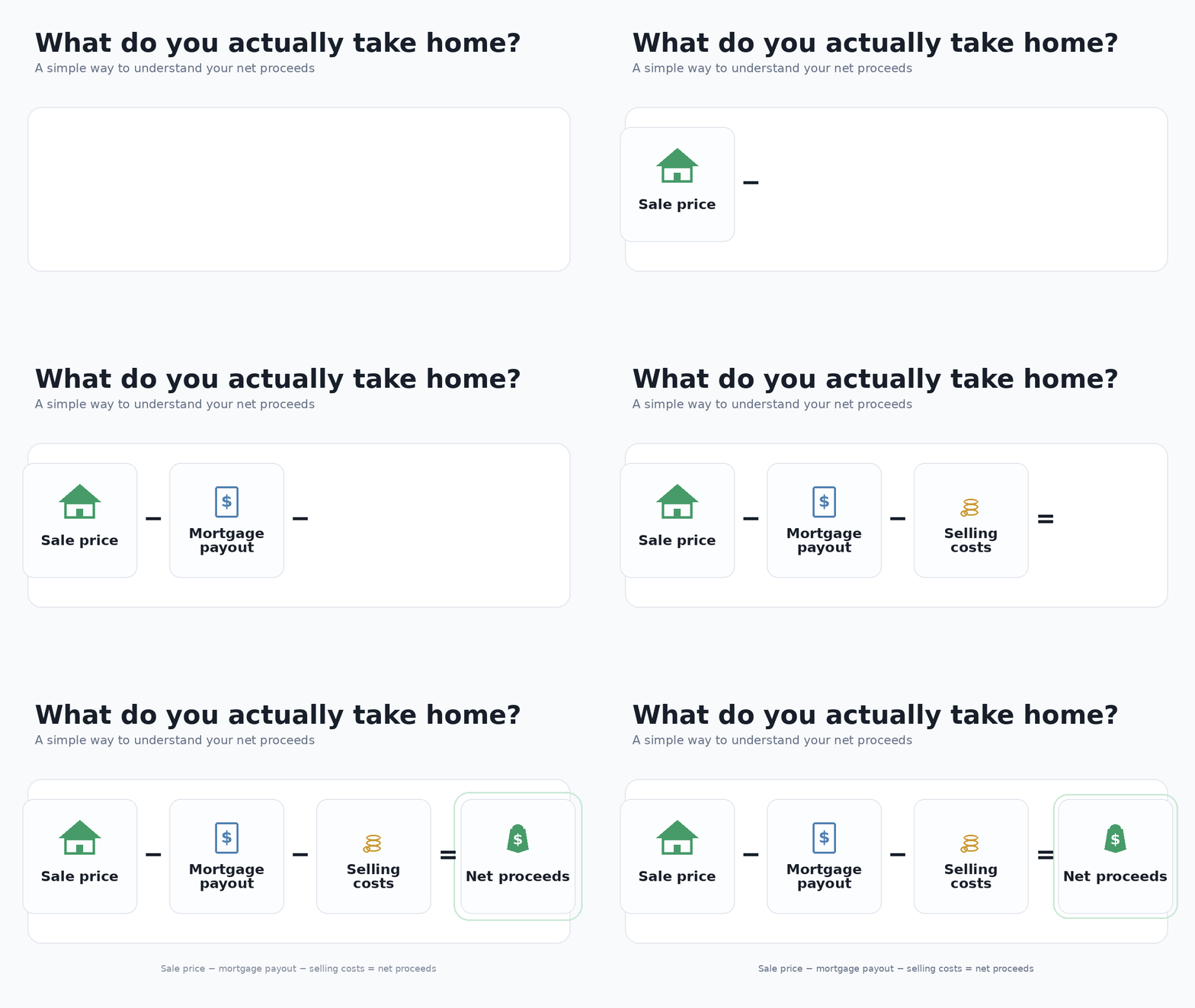
Your net proceeds are what remains after selling your home and paying every cost tied to the sale. This is the number to use when you are deciding how much you can put toward the next down payment, whether you can move up comfortably, or whether selling first makes more sense.
Start with a value range, not one perfect number. A good plan should still work if the sale lands near the lower end of that range. If it only works at the highest number you have in mind, it is not much of a plan yet.
What comes off the top when you sell
The costs are not mysterious, but they are easy to underestimate because they arrive from different places. Some are fixed enough to plan for. Others depend on your mortgage, your property, and how much work the home needs before it goes live.
The important part is to put them all in the same place before you start searching for the next home.
Your mortgage payout
The biggest deduction is usually the remaining balance on your mortgage. Call your lender and ask for a payout statement, not just the balance you see in your banking app. The amount can include daily interest, a discharge fee, and a prepayment penalty if you are ending a closed mortgage early.
That penalty can be small or surprisingly large. Variable-rate mortgages are often simpler to break, while fixed-rate penalties can depend on the lender's interest-rate differential calculation and the remaining term. Do not guess at this number based on what happened to a friend. Get it in writing from your lender before you decide what you can afford next.
Commission and HST
Commission is negotiated. There is no single Ontario rate that applies to every sale, so ask for the exact percentage, what services are included, and whether there are any additional marketing costs before you sign a listing agreement.
Remember the tax. The Canada Revenue Agency says GST or HST applies to an agent's commission and other services related to the sale. In Ontario, that means the quoted commission is not always the final number you should put in your budget. CRA guidance on GST and HST for agent services
A commission number that looks manageable at first can grow once HST is added. That is not a reason to avoid professional marketing or representation. It is a reason to calculate the full cost before you start treating the sale price as available cash.
Legal fees, discharge costs, and adjustments
You will need a real estate lawyer to close the sale, discharge the mortgage, and move the money where it needs to go. The total varies by file, so ask for an estimate that includes disbursements and HST, not just the advertised legal fee.
There can also be adjustments for property taxes, utilities, condo fees, or other prepaid items. If you paid something ahead of time, your lawyer may account for it on closing. These are usually not the costs that derail a move, but they still belong in the spreadsheet.

Preparing the home for sale
This is where people either spend too little or spend in the wrong places.
A deep clean, paint, decluttering, small repairs, photography, and staging can make a real difference in how buyers see your home. A rushed kitchen renovation, a custom backyard project, or expensive finishes nobody else on the street has may not come back to you at sale time.
The right question is not, "What can I upgrade?" It is, "What would make a buyer hesitate?" A tired front door, cluttered rooms, old light fixtures, a leaking faucet, and a half-finished repair can all affect the first impression. Fix the obvious problems before you spend money trying to create a magazine spread.
Moving, storage, and the awkward in-between
Moving costs are easy to ignore when you are focused on the sale. Then you get a firm offer and realize you need movers, boxes, cleaners, storage, hotel nights, or temporary housing if the dates do not line up.
If you are selling before buying, include the cost of a possible short-term rental or staying with family longer than expected. If you are buying before selling, include the cost of carrying both homes for longer than you hope. The cleanest plan is not always the cheapest one, but the expensive parts should not surprise you.
A worked example: what a $1.1 million sale could leave you

Here is a planning example for a homeowner selling a GTA property. These are not standard fees or a promise of what your own sale will cost. They are simply the kind of math that should happen before you choose the next home's price range.
Assume the home sells for $1,100,000. The remaining mortgage balance is $510,000. The negotiated commission is 4 percent, or $44,000, and HST on that commission is $5,720. The homeowner also budgets $7,000 for a mortgage penalty and discharge costs, $2,000 for legal fees and disbursements, and $9,000 for preparation, moving, and storage.
The math looks like this:
Sale price: $1,100,000
Mortgage payout: $510,000
Commission: $44,000
HST on commission: $5,720
Mortgage penalty and discharge costs: $7,000
Legal fees and disbursements: $2,000
Preparation, moving, and storage: $9,000
Estimated net proceeds: $522,280
That is roughly $577,720 less than the sale price. It was never coming with you.
Know that number early, and the rest of the move gets simple. You can make an offer without a financing contingency, skip the bridge-loan scramble, and stop doing math in your head during a negotiation
Now change one thing. If the home sells for $50,000 less than expected, the estimated net proceeds become $472,280 before any other change. That is why a realistic sale range matters so much when you are using the proceeds to buy another property. Know that number early, and the rest of the move gets simple: you can make an offer without a financing contingency, skip the bridge-loan scramble, and stop doing math in your head during the negotiation.
The cost of selling is only half of the move-up budget

Your sale costs tell you what is coming out. Your purchase costs tell you what still needs to go out after that.
Ontario land transfer tax is paid by the buyer when the property is registered. The provincial rate is calculated in brackets based on the purchase price. If you are buying in Toronto, there is also a municipal land transfer tax, which means Toronto buyers can face both taxes. Ontario land transfer tax rates and Toronto municipal land transfer tax rates should be part of your planning before you make an offer.
Then there is the deposit, down payment, legal fees on the purchase, home inspection, appraisal if required, insurance, moving, and the first few purchases that come with a new home. Maybe it is a washer and dryer. Maybe it is window coverings, a fence repair, or a basement that needs work before you can use it.
This is why move-up buyers should not look at their sale and purchase as separate transactions. They are one financial decision with two closing dates.
Realtris AI can help you test a scenario before you are ready to commit. Try asking: "If I sell my home for $1.05 million, owe $510,000, and buy at $1.4 million, what would my mortgage payment look like with 20 percent down?" It can walk through the numbers and let you change the purchase price, down payment, or rate without restarting the whole calculation. Treat it as a practical starting point, then have a mortgage professional confirm what you qualify for.
You can also ask it to find homes that fit the budget you arrive at. A search like, "Find detached homes in Markham under $1.4 million with a main-floor office and a finished basement," is more useful than opening listings you already know are outside your real budget.
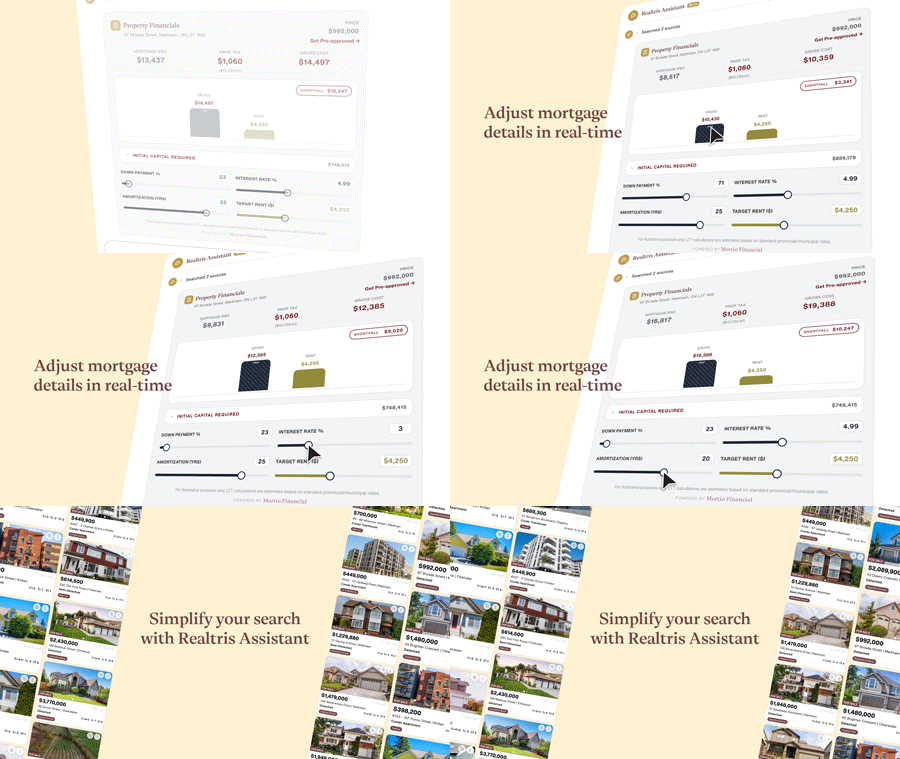
A calculator gives you the numbers. It does not know whether your current home needs a new roof, whether your lender will charge a penalty, or whether the property you want has a condo special assessment coming. Use the tools to get oriented, then use real documents and professional advice to make the final call.
The point is not to predict every dollar perfectly months in advance. It is to stop making decisions with a sale price that was never yours to spend.
The number you should use when planning the next home
Use your conservative net-proceeds estimate as the default. If your home sells above that number, you have a cushion. If it sells at the lower end of the range, you are still in a position to move without scrambling.
This is especially important if you are deciding whether to buy first or sell first. Buying first can make sense when the next home is hard to replace and you have enough cash and financing room to handle a slower sale. Selling first can make more sense when you need the exact proceeds to set your budget or when your current home may take longer to sell.
Neither approach is automatically right. The right one is the one that still works when the sale is slower, the moving costs are higher, or the next home needs more than you planned for.
A professional home evaluation gives you more than a number. It gives you a range, the recent comparable sales behind it, and a clear view of what would need to happen to reach the top of that range. That is the information you need before you build the next chapter of your life around your home's value.
Frequently asked questions
Is real estate commission fixed in Ontario?
No. Commission is negotiated between the seller and brokerage, so ask for the exact percentage, which services are included, and whether there are additional costs. Budget for HST on the commission and related taxable services as well.
Do sellers pay land transfer tax in Ontario?
Land transfer tax is generally a buyer cost, paid when the new property is registered. It still matters to sellers who are buying another home because it reduces the cash available after the sale. Toronto buyers may also pay a separate municipal land transfer tax.
How do I find out my mortgage prepayment penalty?
Ask your lender for a mortgage payout statement. It should show the principal balance, prepayment penalty if any, daily interest, discharge fee, and the date through which the quote is valid. Do not rely on the balance shown in your banking app.
How much should I set aside for preparing my home to sell?
It depends on the home and the local competition. Start with the obvious: cleaning, decluttering, minor repairs, paint, photography, and staging if it makes sense. An agent can help you separate the work that improves buyer confidence from the renovation projects that are unlikely to pay you back.
Does my net proceeds estimate include capital gains tax?
It may not. A principal residence is often treated differently from an investment property, cottage, or rental property. Speak with an accountant or tax professional about your specific situation before assuming a sale has no tax consequences.
Can an online estimate tell me exactly what I will net?
No. An online estimate is a useful starting point for your home's potential value, but it cannot see every condition issue, lender cost, legal adjustment, or preparation expense. Use it to get oriented, then get a professional evaluation and real quotes for the costs that apply to you.
Related reading
- How to Find Out What Your Home Is Worth in Ontario
- Your 2026 Guide to Buying or Selling First in Ontario
- Search Ontario Homes the Way You'd Ask an Agent: First Look at Realtris AI
- Mortgage Calculator