

How to Find Out What Your Home Is Worth in Ontario (2026)

Ask a homeowner what their place is worth and you will usually get a confident number in seconds. It is normally anchored to something: a neighbour's sale, an asking price up the street, or the value from the last mortgage renewal.
Those anchors drift. A neighbour's sale might be from last spring, an asking price is a hope rather than a result, and a renewal figure was set conservatively to protect a loan. The version we see most often at the brokerage is a homeowner comparing their place to a bigger, renovated house two streets over. It rarely is a true comparison, and the difference is not small.
Getting the number right is worth real money. List too high and the home sits, buyers assume something is wrong, and it eventually sells for less than a sharp price would have brought. List too low and you leave money on the table during the busiest week the listing will ever have. This guide explains how to get a number you can stand behind and avoid the mistakes that cost the most.
Your home has three different values
Market value is what a buyer would actually pay today when the home is properly listed and shown. This is the value that matters when you sell.
Assessed value is the figure MPAC assigns for property tax. Ontario assessments are still based on a January 1, 2016 valuation date, so for most homes this figure sits well below what the property would sell for now. It matters for your tax bill and almost nothing else.
Appraised value is a licensed appraiser's written opinion of value on a specific date, usually ordered by a lender before funding a mortgage. It leans conservative by design because the bank is protecting a loan rather than helping you maximize a sale.
When people ask, "What's my home worth?", they mean market value. Three tools get you there, in rising order of accuracy and effort.
Method 1: An online home value estimate
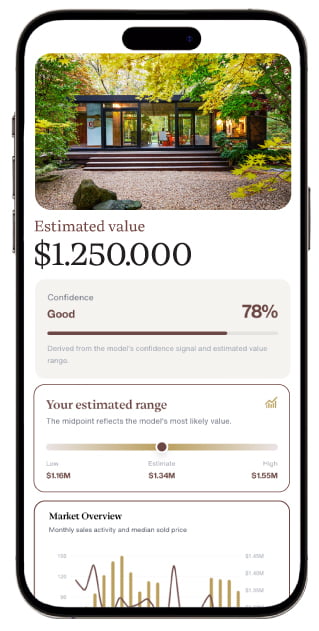
An automated valuation, sometimes called an AVM, is the fastest way to get a number. Enter the address, confirm a few property details, and a model returns a value range built from recent sales, current listings, and traits of similar nearby homes.
It looks at homes near yours that recently sold, weighs them by similarity and recency, and adjusts for data it can see: lot size, floor area, bedroom and bathroom count, age, and property type. It then produces an estimate and a range around it. A wider range means lower confidence, often because there are fewer recent comparable sales nearby.
This is why two sites can show different numbers for the same house. They pull from different data, weigh comparables differently, and update on different schedules. None is the truth. Each is an estimate with different assumptions.
It tells you quickly whether the number in your head is close or badly off. It lets you track equity before you list, and gives you something concrete to check against an agent's estimate later.
The model has never seen your home. It does not know about the renovated kitchen, a foundation crack, a west-facing yard that holds summer sun, or a fence line beside a GO train corridor. It works from averages, so the more unusual the home or the faster the pocket of the market moves, the more it can miss. It also lags because it only learns of a sale after closing and recording.
Read an online estimate as a well-informed opinion from someone who has studied your neighbourhood closely but has never been inside your house. It puts you on the right block. It does not set your list price. Start with a free estimate for a clear, data-informed value range.
Method 2: A comparative market analysis from an agent

A comparative market analysis, or CMA, is what an agent prepares when you are getting ready to list. It is normally free and is the closest thing to a real answer you can get without paying for one.
Sold comparables. Similar homes that actually closed, not homes that merely asked. In Ontario, final sale prices are not freely public in the same way they are in the United States, so this usually requires an agent pulling the data or a paid service.
Active listings. Your competition. If six similar homes are for sale right now, that caps what you can ask, regardless of what sold three months ago.
Expired and terminated listings. Homes that tried to sell and could not. These show where the ceiling is. If three homes like yours listed above a certain price and all failed, that number is a wall.
Days on market and list-to-sale ratio. How long homes are taking to sell and whether they are closing above, at, or below asking. This is the market's temperature, and it changes your strategy as well as your number.
An agent adjusts each comparable sale up or down for the ways it differs from your home. A comparable with a finished basement yours does not have gets adjusted down. One with an older roof gets adjusted up. One on a busier street gets adjusted up. Do this across four or five strong comparables and the numbers should converge on a range.
A CMA is only as honest as the agent writing it. Some agents come in high to win a listing, then push for a price drop a few weeks later. Ask how each comparable was chosen and whether any recent sale argues for a lower number. Someone confident in their pricing will show you both sides.
Method 3: A professional appraisal

An appraisal is a licensed appraiser's formal opinion of value. It usually runs a few hundred dollars. The appraiser inspects and measures the home, notes its condition and features, pulls comparable sales, makes adjustments, and delivers a written report with one supported value as of a specific date.
You do not need one to sell a home. You may need one when a lender requires it to approve or renew a mortgage, when someone is being removed from title in a separation, when settling an estate, or when formally disputing a property tax assessment.
An appraisal can still affect a sale when a buyer's lender comes in below the agreed price. The lender funds a mortgage against the lower value, leaving the buyer to cover the gap in cash. In a fast-moving market, that can cause a deal to fall apart or be renegotiated. It is one reason not to push a buyer to a number recent comparables cannot support.
For a normal sale, a CMA from an agent who knows the local area is usually what you need. Pay for an appraisal when a bank, lawyer, or the CRA is asking.
A worked example: pricing a GTA home
Imagine a detached two-storey in a family neighbourhood: four bedrooms, three bathrooms, about 2,200 square feet above grade, a finished basement, attached double garage, 40-foot lot, late-1990s construction, an updated kitchen from three years ago, original bathrooms, and a quiet interior street.
An agent pulls four recent sales within a short walk.
| Comparable | Sold for | Key differences | Adjusted value |
|---|---|---|---|
| Comparable A | $1,340,000 | Larger lot, renovated bathrooms | $1,300,000 |
| Comparable B | $1,210,000 | Original kitchen and bathrooms, aging roof | $1,255,000 |
| Comparable C | $1,375,000 | Better lot position, finished basement with separate entrance | $1,290,000 |
| Comparable D | $1,265,000 | Busier corner lot | $1,295,000 |
Supported Value Range: $1,275,000 - $1,315,000
The strategy still matters. If there are two competing listings and homes are selling in under two weeks, list near the top of the range and hold firm. If there are eight competing listings and homes are sitting for a month, price at $1,289,000 to be the obvious best value on the street and let traffic build. Comparables give you the range. The current market picks the number inside it.
What actually moves your number

Location, block by block. In the GTA, two homes a ten-minute walk apart can have very different prices and selling pace. School catchment, distance to transit, a quiet loop versus a commuter shortcut, lot position, ravine or park backing, and a busy corner all affect the sale price.
Condition and updates, selectively. Kitchens, bathrooms, roofs, windows, furnaces, and electrical panels return the most at resale because buyers price in what they would otherwise have to spend. A refreshed kitchen and updated bathrooms move the number. A finished basement helps, especially with a legal separate entrance. Pools, elaborate landscaping, home theatres, and finishes nicer than anything else on the street often return only a fraction of their cost.
Layout and usable space. Buyers pay for a workable floor plan, a real main-floor office or fourth bedroom, a functional mudroom, and good flow more than for a large square-footage figure. A choppy 2,400-square-foot home can sell for less than a well-designed 2,100.
Timing. Spring, roughly March through May, is Ontario's busiest selling season, with a second smaller peak in September and October. December and January are typically slower. The same home can attract a different price in February than in April.
The market's temperature. Rates, competing inventory, and buyer confidence set the ceiling. Months of inventory under about four months typically favours sellers, while more than six favours buyers. A sales-to-new-listings ratio above roughly 60 percent is a sellers' market; below about 40 percent is a buyers' market.
Why the answer is a range, not one number
If someone hands you a single figure down to the dollar, be wary. Real valuations are ranges because every comparable sale requires judgment calls, the market shifts week to week, and buyers are not perfectly consistent. The same home can pull offers a few percent apart depending on who appears that weekend.
Where you list inside the range is a strategy call. Price near the top when inventory is tight and demand is strong. Price in the middle when you want steady traffic without frightening buyers. In some markets, a price below the range can launch a bidding war. In slower markets, that move may simply lead to a low sale.
Buyers and their agents anchor on your list price quickly. Come out too high and even after a cut, the history can read as a problem listing. The first two weeks bring the most attention and leverage. Spending them on a test price is one of the costliest seller mistakes.
How to check any estimate you are given

- Are the comparables truly comparable? They should be in the same neighbourhood, with similar size, age, and type, sold in the last three or four months rather than the last year.
- Has the market moved since those sales? In a fast market, even three-month-old comparables need adjusting.
- Were adjustments made for the real differences? Consider basements, lot size, bathroom condition, roof age, and backing.
- Does it pass a gut check? If it feels 15 percent off, find out why. Sometimes the estimate is wrong. Sometimes the number you have been carrying is.
- What would it take to reach the top of the range? An agent can tell you whether that means paint and staging or a full kitchen.
Start with the address
You do not have to be ready to sell to find out where you stand. Most people check well before listing, simply to know.
Start with a free instant estimate to get a range in seconds. If it matches your expectation, you have confirmation. If it is far off, it is better to know now than after you have made plans around the wrong figure. When you want a firm answer, an agent can walk the home and turn that range into a list price with a strategy attached.
Frequently asked questions
How accurate is an online home value estimate?
It is a solid starting point and a poor finish line. Automated estimates are usually within a reasonable band for typical homes in active neighbourhoods and further off for unusual properties, custom renovations, or fast-moving micro-markets. Use one to get oriented, then obtain a CMA before setting a price.
Is a home value estimate the same as an appraisal?
No. An estimate is generated by a model from sales data without an inspection. An appraisal is a licensed appraiser's inspection and written opinion of value for a lender or legal purpose.
Why does my MPAC assessment say my home is worth so much less?
Ontario assessments are still based on a January 1, 2016 valuation date. That figure is for calculating property tax, not for pricing a sale, and for most homes it is well below current market value.
How much does it cost to find out what my home is worth?
An online estimate is free. A CMA from an agent is normally free. A professional appraisal typically costs a few hundred dollars and is only necessary when a lender or lawyer requires one.
How often should I check my home's value?
Once or twice a year is plenty for tracking equity. Check again if rates move sharply, if several homes on your street sell, or if you are within a year of listing.
Should I get an appraisal before I sell?
Usually not. A CMA from an experienced local agent gives you what you need for pricing. Pay for an appraisal when a bank, lawyer, or the CRA requires it.
Related reading
- Your Roadmap to Selling a Home in Ontario
- Real Estate in Markham, Ontario: A Neighbourhood-by-Neighbourhood Guide
- Browse current Ontario listings